
I heard about Matjana Pre-school for the first time through my boyfriend Ron, who told me that his cousin Michelle was one of the co-founders of a pre-school in a rural area of a country called Swaziland.
I love children, and also I have always dreamed of seeing how other different societies live and understand life, so when I heard this story I couldn’t wait to meet Michelle and learn more about the project, about this remote place, its children and its culture. I was so curious that one day I asked if it would be possible to visit. Therefore Michelle put me in contact with Ncoblie, one of the teachers, and after a while I got an email saying I was invited to go.
The rural area where the pre-school is settled is called Kaphunga, and the closest city to Kaphunga, is Manzini. I arrived to Manzini from Johannesburg; cool. But once you are in Manzini for the first time in your life, it doesn’t look that easy to get to Kaphunga by yourself. It seemed like chaos to me, it is such a different place. Plenty of old buses with no destination written on them and everywhere plenty of people walking next to the moving buses. Thank goodness Michelle foresaw this situation and asked a friend of hers, Pinky, if she could come and pick me up from Manzini. Pinky was a good rescuer, and I am happy to say she is the best first friend I could have had. She is kind, attentive, and is a great conversationalist. She came to visit me very often during my stay in Swaziland, and showed me her support the whole time I was there.
There’s just one bus per day to get to Kaphunga, and is an old, noisy one, usually crowded with people and their packages. It felt even more crowded on a hot day like that one. But, it’s also a great place to meet local people of all ages. After about three hours and a half driving through dusty and irregular paths up to the mountain, we arrived!
Pinky, another woman whom I met at the bus, and Ncobile, with the big smile that characterises her was waiting for us at the pre-school, helped me to bring my luggage and food to the accommodation where I would stay for the next few weeks.
I loved it as soon as I saw it. It was a hut of about 3x4 meters on the same block of land as the Preschool, build with sticks and mud and with a corrugated metal roof. It also had two windows, one looking east and the other looking west, so you could see the sunrise and the sunset nicely. The day I arrived I could see the sunset from one and the moonrise from the other. It was magical. Also, you could contemplate the wonderful surrounding landscape from inside, when outside was cold. On the inside of the hut there was a couch, a bunk bed, a chair, a desk, some plastic buckets and a tub, a camping gas cooker and some cooking tools on a big plastic container, which I would later use as food storage during my stay there.
I didn’t know it was still Easter Holidays in Swaziland when I arrived, so kids wouldn’t come to the school over the next few days.
During those days I had time to meet some local people. Ncobile’s mum, Make Zwane, was the first person to come to visit me. She came to welcome me and to check if I was fine and if I needed anything. Bobo, my neighbour, did the same. Another afternoon a young guy named Wonder knocked on my door to invite me to go to Bobo’s house to have tea with them. I was very glad to be invited to join them, as then I would have a better feel of how is a normal rainy day in their lives. When I arrived, I saw they were in one of those round mud huts with a cupule shaped structure and a straw roof. Then I realized I just arrived to the original pre-school, where the Matjana project had begun. It was so exciting!
Inside the hut there were some other guys enjoying an open fire. They would talk to me in English, but mostly they talked in Swazi and I didn’t understand a word of Swazi. I also had to leave a bit sooner than I expected; I would have loved to stay longer if I had been used to having a fire in a closed space. But I couldn’t stop crying and coughing. It was nice and interesting to see how they interact though. I am very thankful to Bobo for being there when I needed something. He also invited me to have yummy Swazi traditional food! Also I am very thankful to Wonder, who, since we met, came with his friend Bryan every afternoon to take me for walks, showing me the area and telling me interesting things about their culture. Afternoons would have been very boring without their company. Also through Wonder I met Queeneth, a young girl whom I really appreciated.
I was given the classroom keys when I arrived, so I could use electricity to charge my torch and my phone. When I first went t to the classroom, I have to say my impression was akin to heartbreak. I felt deeply sad; it was so different to what I am used to, so empty, so grey and cold. Of course I was not expecting any kind of luxury, but directly facing that reality hit me very hard.
Some chairs and desks, beautifully painted in different colours, gave the impression of being in a children’s classroom. There was also a small bookcase with some torn up books, a few old toys at one of the corners, a table with lots of coloured pencils and crayons and some posters on the big walls.
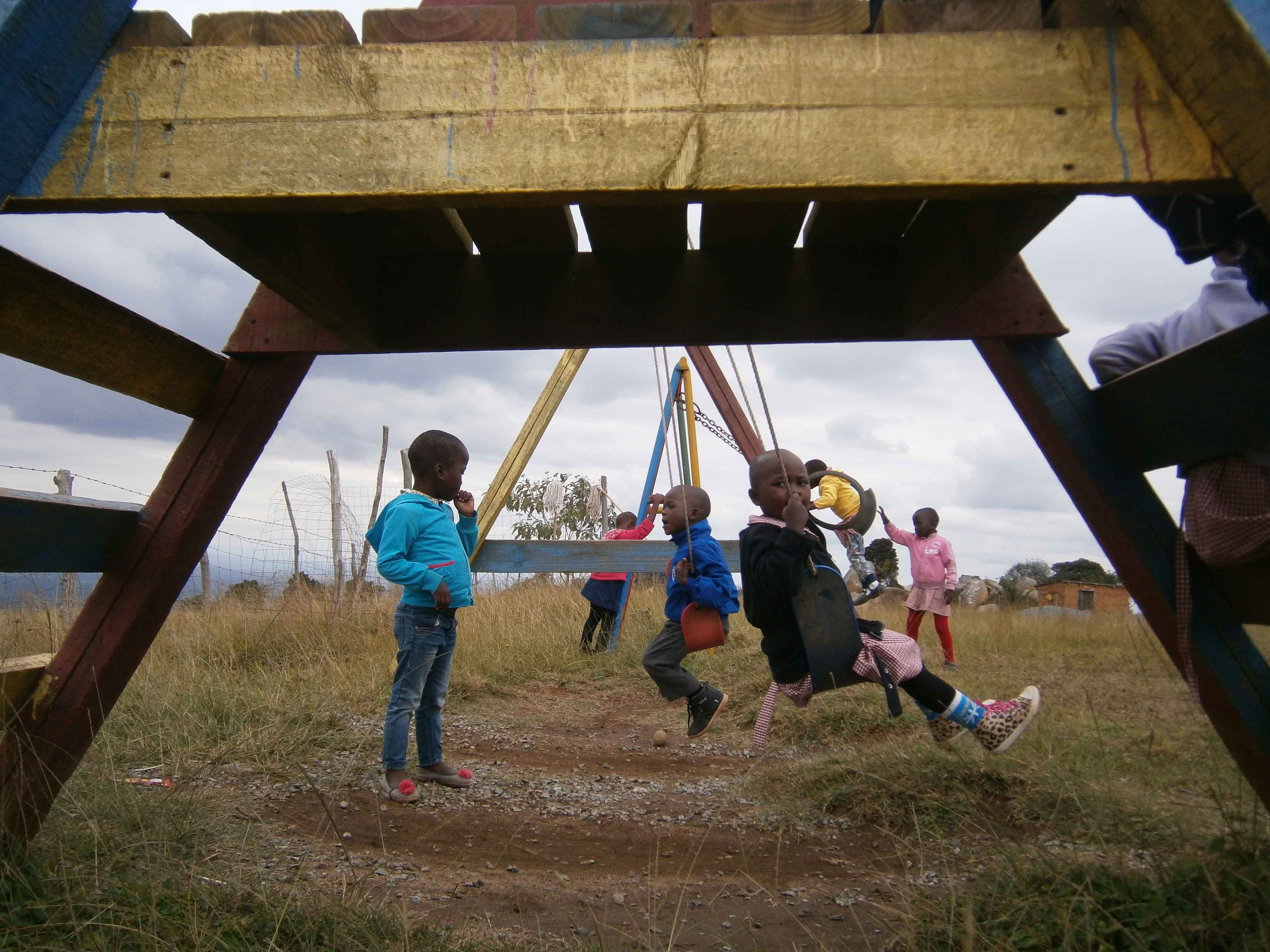
But the return from holidays arrived and immediately my impression changed. It was 7 a.m. and I started to see some kids opening the gates and coming into the school’s playground. Swane was the first teacher to come and when Ncoblie and Londi arrived, we started to prepare the classroom by sweeping and mopping the floor.
At around 8 a.m. about 25 kids got into the classroom. Swane called them and then stated to sing a few songs all together. In one of the songs, to which were clapping along, Swane would say something and
each kid would say their name when asked. That’s how I introduced myself. They also prayed standing up and trying to keep their eyes closed.
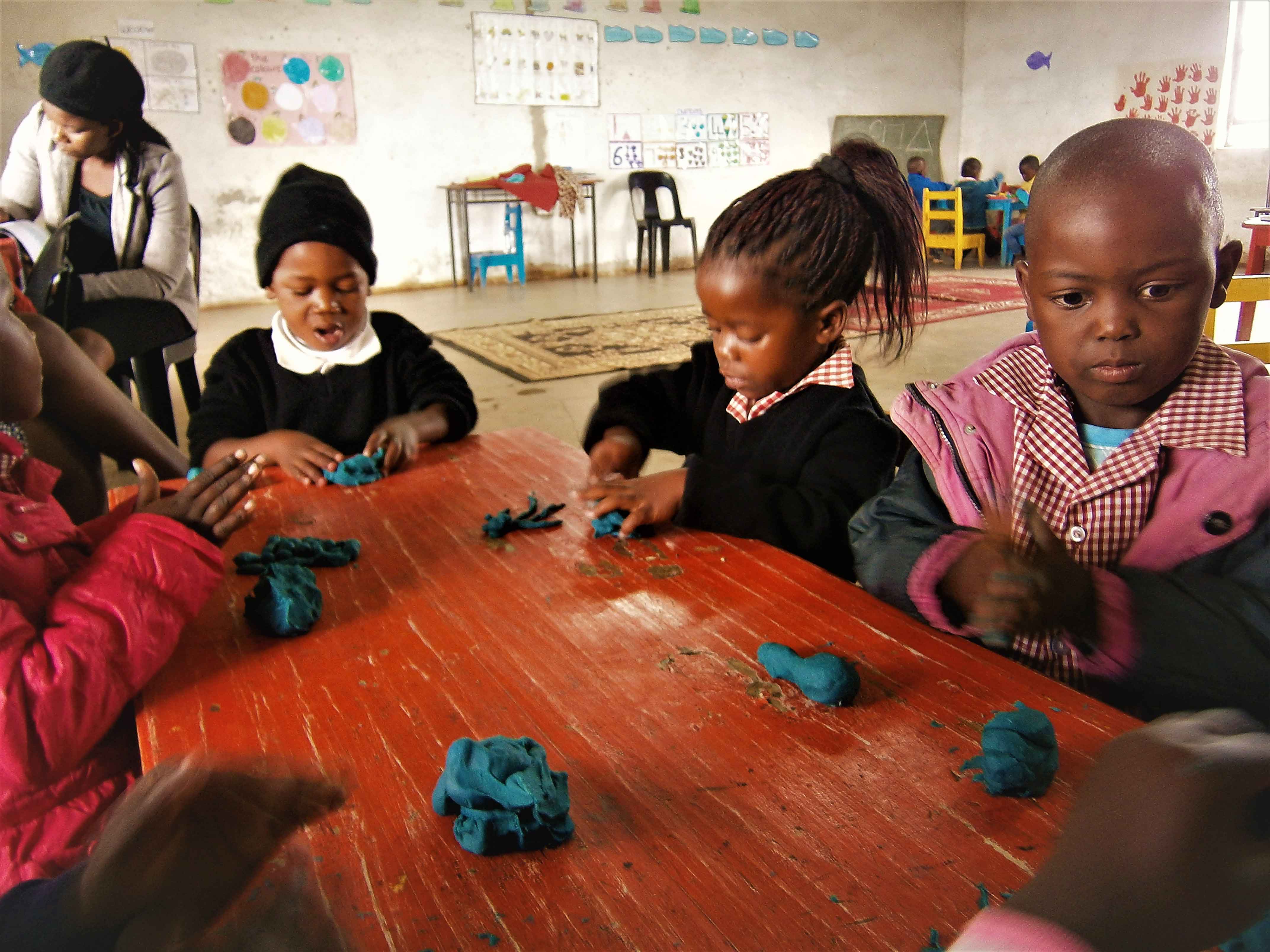
Afterwards they sat on a mat and, when asked to, would stand up and say “I am (name). I am a boy/girl. I live in Ndabeni area. I go to Matjana preschool. I am 5 years old”. Then Ncobile came to introduce the new theme, winter clothes, and used the opportunity to revise the words of colours. Once this was finished, kids went to play in small groups in corners: puzzles, toys, play dough and blocks. This was their daily routine: singing, dancing, playing, drawing, laughing, going to the playground, learning new words in English, and sharing experiences under the same roof.
I was delighted seeing how bubbly the kids were, moving around loudly and with endless energy. Some of them were cheeky, others were shy. I remember a tall boy displaying in many situations a very diplomatic behaviour for his age; another boy with a strong character who seemed to have low tolerance for frustration; a girl who was sad because she badly wanted to be with her mum, who was just a few meters away outside the school and after a while we realised she had slipped away to be with her mum. I remember not understanding a word of what they were saying, but comprehending their nature just by observing them.
After this first day my point of view of the pre-school totally changed and I came to know that what matters in a school has absolutely nothing to do with how it looks like and what there is in it, but with the people in it and what they do.
On the other hand, I also realised that what we have around us determines to a large extent our possibilities, our way of living, and in a certain way even our personality. I could see how people take their time to do their daily routines. They walk calmly and slowly; I also found kids and people running for pleasure. They talk the same way. They work the same way. They don’t need to rush at all. I admired that. Of course if they have to meet to discuss or work on something, they will agree on a time, but there is flexibility. If someone can’t be punctual, they will just arrive and everything will keep going on without reproachful looks or interruptions.

I didn’t see anybody stressed about the inessential things that sometimes stress me out. I felt like they knew better how to take advantage of the time at their disposal. Unfortunately, this attitude seems to be an unreachable delusion in my society. I live in a busy environment surrounded by too many distracting things and where having free time just to do nothing is considered wrong. You always have to be doing something. If you want to do nothing or get bored you have to call it yoga or meditation, so it sounds like if you are busy again.
At the preschool, teachers had everything organized and under control. Some days, at the end of the class, I would suggest playing traditional Spanish games together. I would first explain to the teacher the activity and rules and then the teacher would explain it to the kids. We had some fun pretending we were a long train going under a tunnel or chasing our friends trying to get them before they reach the safe place. Language was the biggest barrier for me as I couldn’t communicate directly by spoken language with the kids, so I didn’t really know what I could do or how I could help out. It was fun to play with the kids at the playground during the break, but I travelled all the way to Kaphunga with a different purpose than just observing kids. Then I thought I could cook for them, and when I asked the teachers they told me I could.
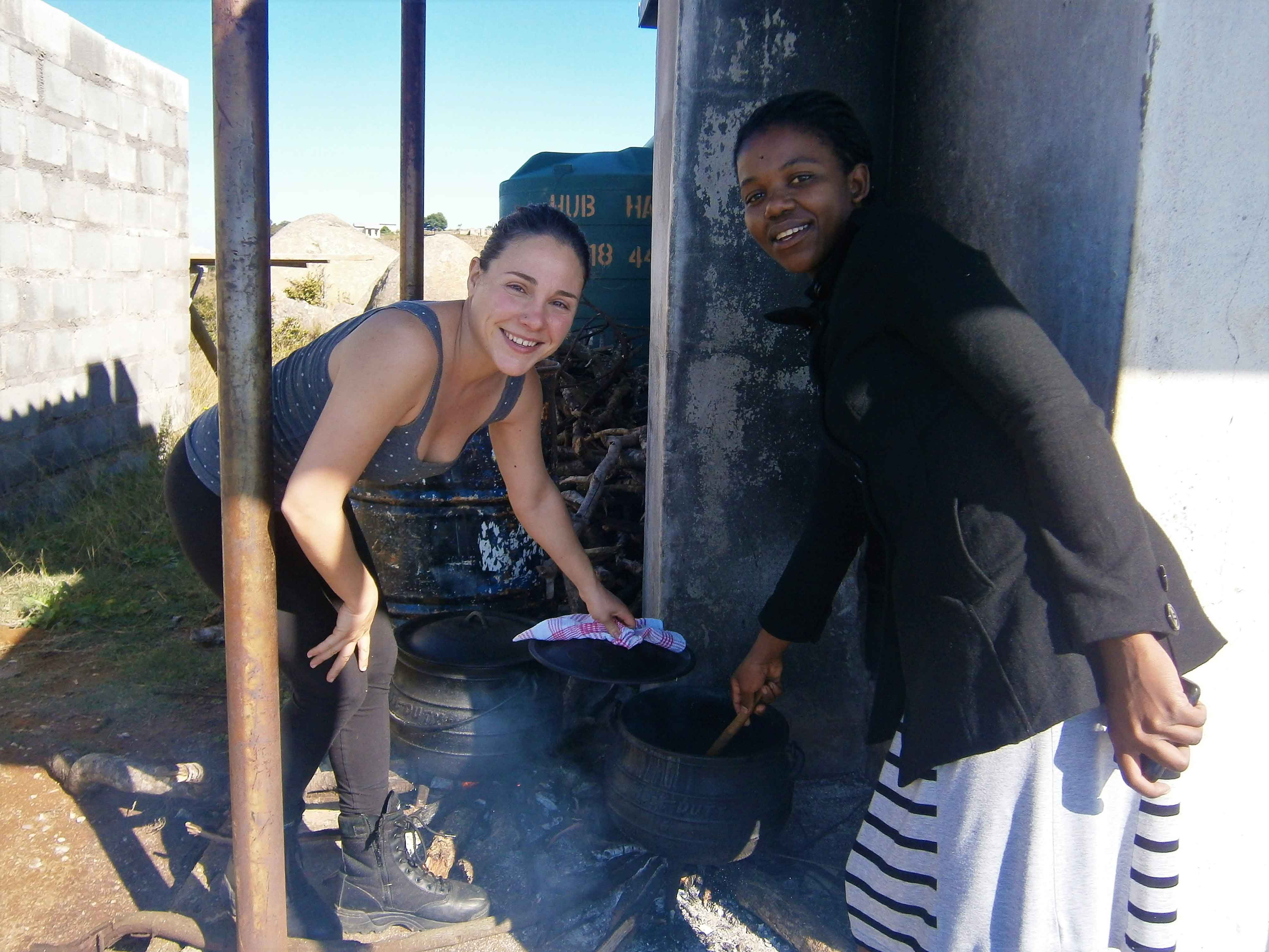
I wanted to cook something special that they had never tried before and that they might never have the opportunity to eat again. Seriously? What were you thinking, Silvia!? Everybody knows kids just want to eat what they know; they are not going to be happy tasting random strange foods. But believe it or not, I thought about kids’ preferences and decided the first meal I would prepare would be pasta. All kids like pasta. But wait, what kids? Not the Swazi ones.
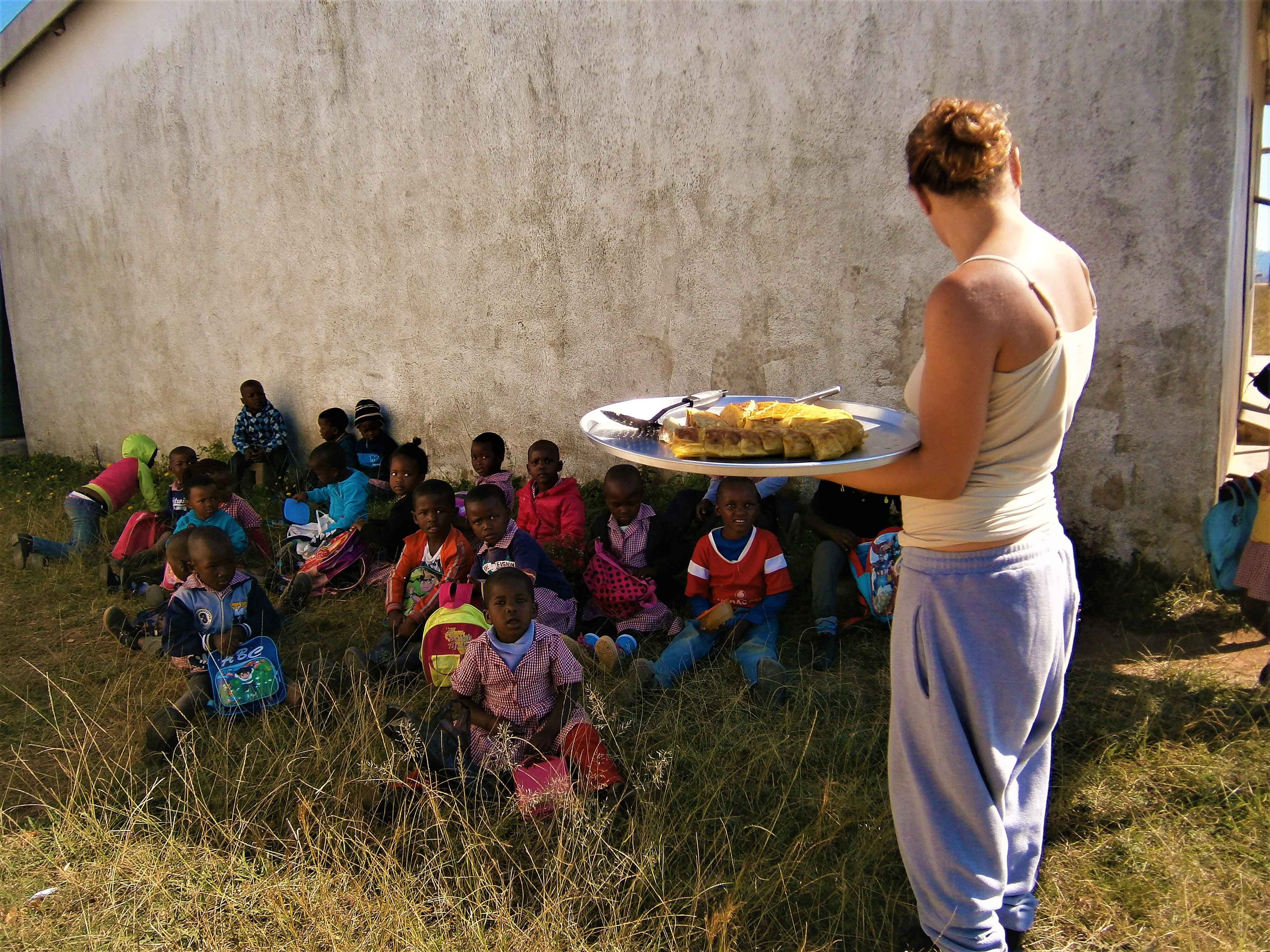
It was a bit disappointing that, after spending the whole previous day away at Manzini. It was a big issue for me that there was just a bus to go at 7a.m. and just a bus to return at 5.30pm and I had to waste a total of 7 hours on it if I wanted to go grocery shopping. After bringing back as much food as one person can carry, and after cooking 5kg of pasta plus about another 5 kg of sauce over a wood fire, when I gave each kid a plate full of pasta, they looked at me as if to say, “well, and where is my pap to eat?”. It was tense moment. The 30 kids kept staring at their plates for a while before starting to eat. It was a relief to see that they finally did so. There were two kids, though, that continued staring alternatively at the food and at me before standing up and leaving the plates intact. But I was very happy that I succeeded in buying a big jar of Nutella, because yes, all kids love chocolate.
I didn’t know how to cook pap, which is one of their staple foods and consists of mixing boiling water with maize corn flour. But at least I learnt that I had to use familiar ingredients for the next dishes. I couldn’t cook as often as I would have liked to because of the necessity to go shopping again by bus, as already explained and because I couldn’t carry or storage so much food and I didn’t want to bother anyone with my chef issues. Anyhow, I can say next few meals were not so shocking for the kids.
I realised how naïve I was after seeing the pre-school for the first time, thinking that it was a pity that they didn’t have better quality toys or many new books at the pre-school. They didn’t even have blank paper sheets. But those things don’t matter when even the basic needs are not covered. I have no doubt those kids and their families’ struggles are far away from a fantasy coloured school. The pre-school also represents a support to the community. That’s why they are hoping to enlarge the preschool to increase the number of pupils they can accept.
They built the school themselves, I think mostly mothers and grandmothers. I saw them working on the ground with the shovels, even while carrying their babies on their backs. Thus, more kids will enjoy the opportunity to learn at such a lovely preschool.
I would like to thank all the people I met at Swaziland that made my unique experience all the more fantastic for being there. I would love to go back someday to see the progress of the preschool and the warm and friendly smiles of the locals.
I want to finish by saying to those who can afford and are willing to help others, that any amount of money they donate makes a real and direct difference at Matjana Preschool. Charities can often have their funds diluted due to their size, scale and unfortunately at times corruption which results in many of us being wary to donate. I can assure you that every cent you donate for this cause goes directly to the pre-school to enlarge it and educate the rural children of the Kaphunga Province of Swaziland.